
February 26, 2026
US Tariff Refund Strategy for Importers
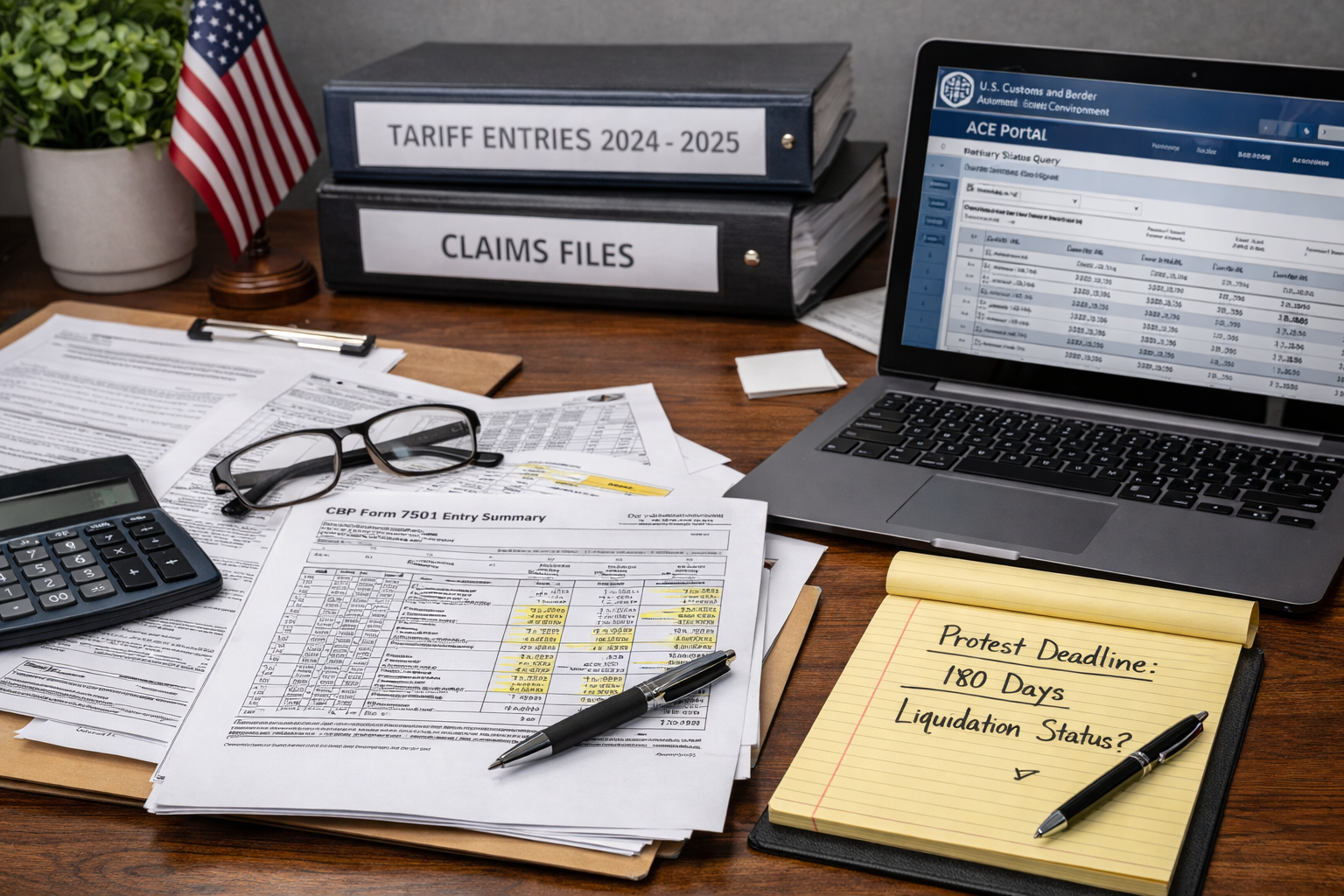
The Supreme Court’s decision invalidating the IEEPA-based tariffs marked a major legal shift for US importers. However, while the ruling clarified the limits of executive authority, it did not automatically create a nationwide refund mechanism. US tariff refund recovery remains governed by Customs and Border Protection procedures, liquidation timelines, and statutory protest rules. The opportunity to recover overpaid customs duties exists, but it is procedural, evolving, and time-sensitive.
The tariffs in question were implemented in stages throughout 2025. Initial measures were scheduled to begin on February 4, 2025. Major IEEPA tariffs entered into force on March 4, 2025. A broad 10 percent baseline tariff became effective between April 5 and April 9, 2025. Additional higher tariff rates followed on August 7, 2025. From March through the end of 2025, importers paid significant additional duties at the time of entry. For many companies, tariff exposure accumulated into substantial sums.
Refund eligibility, however, is not determined by announcement dates. It is determined by liquidation.
Under 19 U.S.C. §1514, once CBP liquidates an entry, the importer has 180 days to file a protest. If no protest is filed within that period, the liquidation becomes final and conclusive. Liquidation finality is one of the strongest principles in US customs law. In most cases, consumption entries liquidate approximately 314 days after filing unless liquidation is extended. As a result, entries filed in March 2025 typically liquidated around January 2026. Entries filed in April 2025 typically liquidated around February or March 2026. Later 2025 entries may still be unliquidated.
For many importers today, a significant portion of their 2025 tariff exposure is either unliquidated or within the 180-day protest window. That window is critical under current law.
It is important to be precise about what the Supreme Court ruling did and did not do. The Court invalidated the statutory authority used for the tariffs. It did not automatically reopen finalized entries or issue blanket refunds. Depending on entry status, recovery may require filing a Post Summary Correction for unliquidated entries, filing a formal protest within 180 days of liquidation, coordinating strategy involving the Court of International Trade, or monitoring potential administrative or legislative implementation guidance.
At the same time, history shows that liquidation finality can be modified in extraordinary circumstances through explicit legislative or judicial action. Trade law provides several examples. During the implementation of the Central America–Dominican Republic Free Trade Agreement, Congress enacted legislation that allowed certain retroactive claims and adjustments for qualifying entries. In that context, relief mechanisms were expressly authorized by statute. Similarly, during lapses of the Generalized System of Preferences program, Congress later renewed the program retroactively and authorized refunds for eligible entries made during the lapse period. In both situations, liquidation outcomes were affected because Congress provided specific authority.
Section 232 steel and aluminum tariffs and Section 301 China tariffs also created structured exclusion processes that allowed for retroactive relief when exclusions were granted. In those cases, refunds were issued under defined administrative procedures. Relief was not automatic; it required application and compliance with established mechanisms.
These historical examples demonstrate an important principle. Liquidation finality can be modified, but only through explicit legal direction. Until such direction is formally enacted in the present tariff context, the 180-day protest rule remains the governing framework.
In practice, there is a structured methodology typically used when executing a tariff refund recovery process. However, it is important to acknowledge that final administrative guidance or congressional action has not yet been fully established. The government or Congress could act in ways that adjust procedures or create broader relief mechanisms. Until that occurs, disciplined preparation under existing customs law remains the prudent course.
A structured recovery approach generally includes pulling complete ACE liquidation reports for all impacted entries, segmenting entries into unliquidated, liquidated within 180 days, and liquidated beyond 180 days, evaluating Post Summary Correction eligibility for open entries, preparing and filing protests for entries within the 180-day window, and monitoring developments at the Court of International Trade as well as potential congressional action. These steps reflect standard compliance practice under current law. Future judicial or legislative developments could alter the framework, but relying solely on potential change introduces risk.
For many importers, tariff exposure from March through December 2025 represents significant financial impact. Recovery of overpaid customs duties may materially affect financial statements, cash flow, and customer pricing decisions. Yet recovery of significant tariff sums is not a simple amendment. It is a structured compliance initiative involving entry-level analysis, liquidation tracking, documentation validation, deadline management, and strategic coordination.
The most important point is this: entries continue to liquidate and protest clocks continue to run. While macro-level clarity has improved, operational mechanics remain procedural. Companies that prepare early preserve flexibility. Companies that wait assume that broader relief will materialize and apply automatically.
Partner selection therefore becomes critical. Importers must determine who will analyze entry-level exposure, who will track liquidation status, who will manage protest filings within statutory deadlines, and how coordination with legal counsel will occur if litigation becomes necessary. Waiting until deadlines approach increases operational risk and compresses decision-making under pressure.
PNG WORLDWIDE is actively monitoring developments related to the Supreme Court ruling and subsequent CBP implementation guidance. We are assisting importers with comprehensive entry universe analysis, liquidation verification, protest strategy development, Post Summary Correction review, and coordination with counsel where appropriate. We recognize that historical precedent shows liquidation finality can be modified through legislative or judicial action. However, until such action is formally enacted in this context, the existing protest framework governs.
We encourage importers to reach out and formalize engagements now. Recovery of significant tariff sums will require structured planning, defined accountability, and disciplined execution. While future government or congressional action may refine or expand relief mechanisms, preparing under current law protects rights and positions importers to respond quickly to any new developments.
The IEEPA-based tariffs were implemented beginning in March 2025 and expanded throughout 2025. Many affected entries are now liquidating in 2026, triggering the 180-day protest window. The 180-day rule remains the operative standard today. Trade history demonstrates that extraordinary relief mechanisms can be created, but they require explicit legal authority.
Importers who act deliberately preserve their position. Importers who wait assume future policy will reopen their rights. The Supreme Court decision created opportunity. The outcome now depends on disciplined execution. PNG WORLDWIDE stands ready to assist importers in navigating US tariff refund claims with clarity, structure, and professional guidance.