
SOC: Confidence Beyond the Shipment
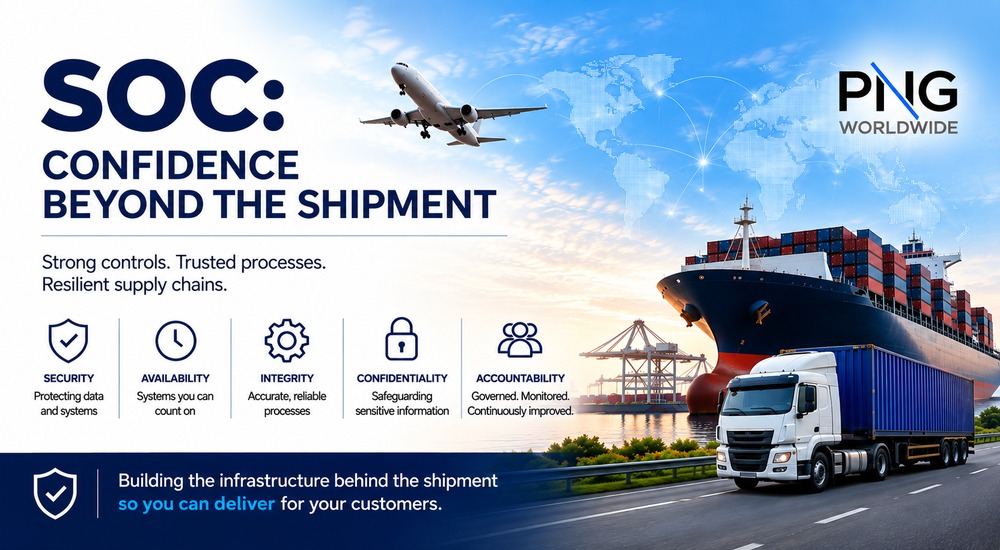
Supply chains have always faced disruption, but the level of complexity and interdependence companies manage today is fundamentally different. Manufacturers, distributors, retailers, and other large organizations increasingly depend on global suppliers, transportation providers, technology platforms, warehouses, financial systems, customs processes, and third-party partners that all need to work together.
For publicly traded companies and private-equity-owned organizations in particular, supply chain performance is no longer measured only by freight cost and transit time. Management teams, boards, investors, procurement departments, finance organizations, IT teams, and auditors increasingly expect transportation and logistics partners to demonstrate strong governance, disciplined internal controls, reliable technology, financial accountability, and the ability to respond effectively when disruptions occur.
That expectation is changing the role of the modern logistics provider.
At PNG Worldwide and PNG Logistics, we believe our responsibility goes well beyond finding a carrier and moving a shipment from Point A to Point B. Our role is to help customers build transportation and supply chain processes that are more reliable, more transparent, more accountable, and better prepared for change.
This is especially important for organizations operating complex domestic and international transportation networks. A disruption affecting a port, ocean carrier, trucking provider, supplier, technology system, customs process, or payment platform can quickly move beyond transportation and become a production, customer service, financial, or business continuity issue.
A delayed container can interrupt manufacturing. A carrier capacity shortage can affect customer deliveries. A technology outage can prevent hundreds of shipments from being processed. Incorrect shipment data can create billing and reporting problems. Weak financial controls can affect carrier relationships and payment accuracy. A cybersecurity incident can create risks far beyond the transportation department.
For our customers, the value of PNG Worldwide and PNG Logistics is increasingly found in helping manage these interconnected risks across both international and domestic transportation.
Internationally, PNG Worldwide supports customers across ocean freight, air freight, customs brokerage, and related global logistics activities. Domestically, PNG Logistics manages complex LTL, truckload, and transportation management programs across broad carrier networks. Together, these capabilities give customers the ability to work with a logistics organization that can see transportation as one connected supply chain rather than as isolated transactions.
That broader visibility matters.
When international freight enters the United States, the supply chain does not suddenly become a separate domestic process. Customs clearance, drayage, warehousing, truckload, LTL, final delivery, freight settlement, shipment visibility, and reporting are all connected. The more fragmented those responsibilities become, the more opportunities there are for delays, inconsistent information, duplicated work, or unclear accountability.
Our objective is to reduce that fragmentation.
Technology plays an increasingly important role in accomplishing that. Modern transportation management systems connect shippers, receivers, carriers, warehouses, purchasing teams, customer service departments, finance teams, and management. APIs, EDI connections, carrier integrations, tracking systems, automated rating, auditing, settlement, and reporting now support much of the transportation process.
Technology creates significant efficiencies, but it also creates dependency. Customers need confidence that the systems supporting their transportation programs are secure, available, controlled, and properly managed.
For that reason, PNG Worldwide has been advancing a multi-year SOC 1 Type II and SOC 2 Type II readiness and examination initiative for its carrier payment and settlement services system since March 2026, supported by an independent specialized CPA firm.
The initiative includes formalizing and documenting internal controls, risk management practices, technology controls, financial processes, and management oversight across the in-scope service environment. The SOC 2 Type II examination is focused on controls related to the security and availability of the in-scope system, while the SOC 1 work addresses controls relevant to the financial processes within the defined service environment.
This work is particularly relevant to the types of organizations we serve.
Publicly traded companies frequently operate within strict financial reporting, information security, procurement, and audit environments. Private-equity-owned companies face many of the same expectations, often combined with aggressive operational improvement targets, integration initiatives, acquisition strategies, and eventual exit requirements.
In both environments, transportation partners increasingly become part of the customer’s broader control environment.
When a logistics provider manages significant freight volumes, carrier payments, shipment data, technology integrations, and transportation decisions, customers need more than assurances that controls exist. They increasingly need documented processes, clearly assigned responsibilities, consistent management oversight, reliable data, and an organization capable of supporting their own governance requirements.
That is where we believe the investment PNG is making creates meaningful value.
Strong internal controls improve accountability. Formalized procedures reduce dependency on individual employees. Better access management reduces technology risk. Defined change management helps protect system reliability. Documented financial controls strengthen payment and settlement processes. Business continuity planning improves organizational preparedness. Consistent management review allows potential problems to be identified and addressed before they become customer problems.
None of this eliminates disruption.
Ports will close. Weather will affect transportation. Carriers will experience capacity problems. Equipment shortages will occur. Technology will occasionally fail. Suppliers will miss commitments. Geopolitical events and regulatory changes will continue affecting global trade.
The difference is how prepared an organization is when those events occur.
For our customers, PNG Worldwide and PNG Logistics are working to provide more than transportation capacity. We are building the infrastructure, technology, controls, carrier relationships, operating processes, and management discipline necessary to help customers navigate a supply chain environment that will continue becoming more complex.
Our goal is straightforward: provide customers with competitive transportation solutions while also giving their management, procurement, finance, IT, and supply chain teams greater confidence in the processes supporting those shipments.
For sophisticated companies, particularly publicly traded and private-equity-owned organizations, that combination is becoming increasingly important.
The future of logistics will not belong simply to the company capable of obtaining the lowest freight rate. It will belong to organizations capable of combining competitive transportation procurement with technology, visibility, governance, financial discipline, operational accountability, and resilience.
That is the direction in which PNG Worldwide and PNG Logistics continue to invest, because the infrastructure behind the shipment is becoming just as important as the shipment itself.
View All News Articles