
Rising Bunker Prices and Geopolitical Risk Continue Pressuring Global Supply Chains
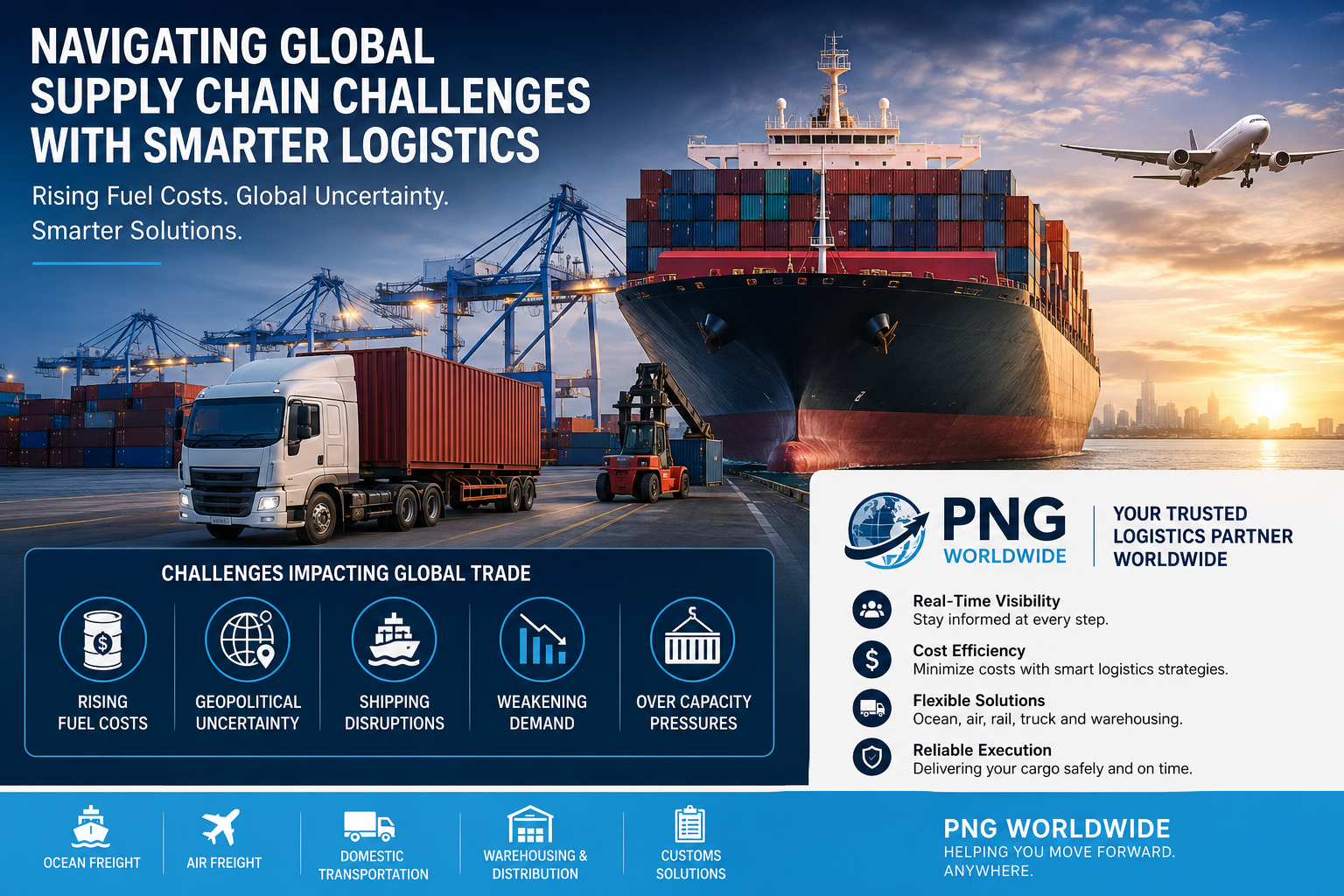
Global supply chains are once again entering a period of significant instability. Rising bunker fuel costs, geopolitical tensions in the Middle East, weakening consumer confidence, and ongoing overcapacity across the ocean shipping industry are creating new challenges for importers, exporters, manufacturers, distributors, and retailers worldwide.
For companies dependent on international shipping and reliable freight transportation, the current logistics environment is becoming increasingly difficult to predict and even harder to control.
Recent statements from Maersk CEO Vincent Clerc highlight how rapidly global transportation costs are changing. According to Maersk, the company’s monthly bunker fuel expense has doubled to approximately $500 million since the conflict in the Middle East escalated, with those additional costs now being passed directly to customers through fuel surcharges and revised bunker pricing formulas.
Although major ocean carriers are currently recovering those higher operating costs through increased spot rates and fuel surcharges, growing concerns remain throughout the logistics industry regarding how long transportation markets can sustain rising shipping costs if consumer demand continues weakening.
This growing imbalance between rising operating expenses and softening global demand is creating serious uncertainty across international freight markets.
One of the largest pressure points impacting global logistics is the Strait of Hormuz, one of the world’s most strategically important shipping corridors. Approximately 20% of global oil and gas exports move through the region, and ongoing instability has severely disrupted bunker fuel availability across major Asian ports and marine refueling hubs.
The impact on international shipping operations has been immediate.
Bunker refueling lead times in Singapore and several Japanese ports have expanded dramatically, forcing ocean carriers to adjust refueling strategies, reroute vessels, and reevaluate global transportation planning.
As traditional bunker fuel hubs become increasingly congested, alternative ports such as Zhoushan, Hong Kong, Port Klang, Tanjung Pelepas, and Port Louis are seeing substantial increases in demand from container carriers searching for stable fuel access.
Shipping lines are also adopting increasingly aggressive fuel management strategies. According to analysts, many carriers are now engaging in “extreme tankering,” maximizing fuel loading in Europe or the United States to avoid uncertainty and fuel shortages throughout Asia and the Indian Ocean.
At the same time, rising bunker fuel costs are forcing ocean carriers to reconsider sailing speeds across major global trade lanes.
Maersk indicated that reducing vessel speeds from 16-17 knots to approximately 14.5-15 knots may become economically necessary under current fuel market conditions.
While slow steaming may reduce fuel consumption and help absorb excess vessel capacity, it also creates longer transit times, increased inventory pressure, and additional forecasting challenges for companies managing international supply chains.
For importers and exporters, balancing transportation cost control with supply chain reliability is becoming increasingly difficult.
At the same time transportation costs continue rising, demand forecasts are weakening across key global markets.
According to the National Retail Federation and Hackett Associates, the traditional U.S. peak shipping season may effectively disappear again in 2026 as retailers remain cautious about inventory replenishment due to weak consumer confidence, inflationary pressure, and geopolitical uncertainty.
Forecasts for August and September containerized imports, traditionally the strongest months of the year for ocean freight demand, are now projected to decline year over year.
Consumer sentiment also continues deteriorating as fuel prices and inflation place additional pressure on household spending. The University of Michigan Consumer Sentiment Index recently fell to historically weak levels, reflecting ongoing concerns about gasoline prices, tariffs, and broader economic instability.
For the global shipping and logistics industry, this creates a highly unstable environment.
Ocean carriers are simultaneously facing:
- Rising bunker fuel costs
- Supply chain rerouting expenses
- Security risks across major shipping corridors
- Weakening consumer demand
- Excess vessel capacity
- Slowing import growth
- Pressure to maintain profitability
- Increasing geopolitical uncertainty
Compounding these challenges is the massive amount of new vessel capacity still scheduled to enter the market.
The global container ship orderbook now stands at approximately 12 million TEUs, representing nearly 36% of the active global fleet.
Without aggressive capacity management through slow steaming, blank sailings, or vessel scrapping, the container shipping industry risks entering another period of severe freight rate pressure despite rising operating expenses.
For businesses dependent on international trade, these conditions create enormous uncertainty.
Transportation costs can fluctuate rapidly. Ocean transit schedules remain unstable. Fuel surcharges continue changing. Inventory planning becomes more difficult. Geopolitical developments can instantly disrupt global trade lanes and impact delivery performance across supply chains worldwide.
In this environment, companies can no longer rely solely on transactional freight management.
Modern supply chains require flexibility, real-time visibility, proactive logistics planning, and rapid decision-making capabilities.
Businesses are increasingly reevaluating:
- Ocean freight procurement strategies
- Carrier diversification
- Fuel surcharge exposure
- Inventory allocation models
- Domestic distribution networks
- Shipment consolidation opportunities
- Supply chain forecasting methods
- Transit risk management
- Alternative sourcing strategies
The companies that successfully navigate today’s volatile transportation market will likely be those capable of adapting quickly while maintaining operational control and logistics visibility.
As global transportation volatility continues accelerating, businesses need logistics partners capable of delivering operational stability and cost-efficient supply chain solutions.
PNG Worldwide continues helping customers navigate these complex market conditions through international freight forwarding, domestic transportation management, supply chain optimization, multimodal logistics solutions, customs coordination, and technology-driven shipment visibility tools designed for today’s rapidly changing transportation environment.
In a market defined by uncertainty, flexibility and strategic logistics management have never been more important.
PNG Worldwide helps customers stay informed, minimize transportation costs, and maintain supply chain stability during volatile global market conditions.
Through real-time logistics visibility, strategic freight management, multimodal transportation solutions, and proactive communication, PNG Worldwide helps importers, exporters, manufacturers, and distributors navigate rising fuel costs, carrier disruptions, geopolitical uncertainty, and changing freight market conditions.
As supply chains become more complex and transportation markets more unpredictable, businesses need more than a freight provider. They need a logistics partner capable of delivering flexibility, cost control, operational transparency, and reliable execution across domestic and international transportation networks.
PNG Worldwide continues helping customers reduce risk, improve efficiency, and make smarter supply chain decisions in an increasingly challenging global logistics environment.
View All News Articles