
CAPE Phase 3: IEEPA Refunds
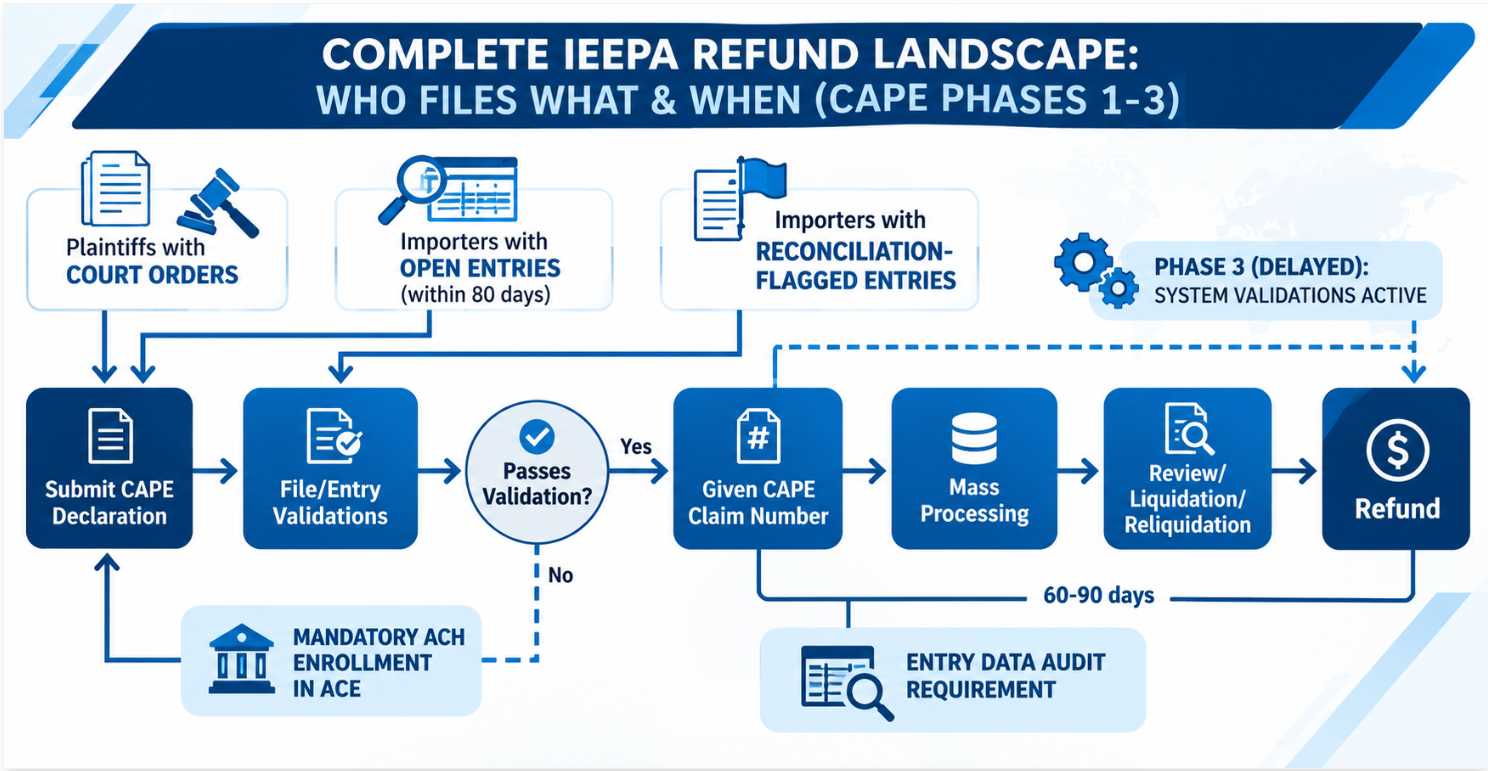
PNG Worldwide’s U.S. Customs Brokerage team has already successfully recovered millions of dollars in IEEPA tariff refunds for our customers through the earlier phases of the federal refund process. That success has come from detailed entry-level analysis, careful attention to liquidation status and duty information, and, most importantly, the trust our customers have placed in PNG Worldwide to manage this complex process on their behalf.
With Phase 3 of the Consolidated Administration and Processing of Entries, or CAPE, scheduled to begin on October 6, 2026, another important group of importers may soon have a path toward recovering IEEPA duties associated with older, finally liquidated entries.
Phase 3 represents the latest development in a refund process that began following a landmark U.S. Supreme Court decision earlier this year.
The underlying issue dates back to 2025, when tariffs were imposed under the International Emergency Economic Powers Act, commonly known as IEEPA. The statute provides the President with broad powers to regulate economic transactions during declared national emergencies, but the use of IEEPA to impose broad tariffs on imported merchandise was challenged in federal court.
On February 20, 2026, the U.S. Supreme Court ruled that IEEPA did not provide the statutory authority necessary to impose the tariffs at issue. The Court emphasized that when Congress authorizes tariffs, it normally does so explicitly and within defined limitations. The ruling set in motion an unprecedented customs refund process involving millions of import entries and an enormous amount of duties previously collected by U.S. Customs and Border Protection.
The practical challenge was significant. CBP could not realistically process millions of affected customs entries manually. As a result, CBP developed CAPE within the Automated Commercial Environment, or ACE, to automate much of the refund process.
Rather than opening every affected entry simultaneously, CBP divided the program into phases based largely on the status of the customs entries involved.
Phase 1 launched in April 2026 and generally addressed entries that remained unliquidated, along with entries that had liquidated recently enough to remain within the administrative period during which CBP could process the refund.
Liquidation is an important concept in understanding the entire process. When CBP liquidates an entry, it finalizes the amount of duties owed on that import transaction. Once an entry liquidates, specific time periods begin running during which an importer can challenge or otherwise address the liquidation. Eventually, an entry becomes final, and CBP’s administrative ability to reopen it becomes much more limited.
Phase 2 followed in June 2026 and expanded CAPE to certain entries that had been flagged for reconciliation but for which a Reconciliation Entry had not yet been filed. This allowed another significant population of IEEPA-affected entries to become eligible for the automated recovery process.
Through these first two phases, importers have already recovered very substantial amounts of money.
For PNG Worldwide customers, this process has been especially significant. Our U.S. Customs Brokerage team has analyzed entries individually, identified qualifying IEEPA duties, reviewed liquidation status, prepared the appropriate submissions and followed claims through the refund process.
That detailed approach has already resulted in millions of dollars being successfully recovered for our customers.
Phase 3 addresses a more complicated category: finally liquidated entries.
These are older entries that have moved beyond the normal administrative periods available for routine correction or protest. Until now, these entries generally could not be processed through CAPE simply because CBP no longer had the same administrative authority to reopen them.
That is where the U.S. Court of International Trade becomes particularly important.
CBP has taken the position that, for finally liquidated entries, an importer generally needs a specific court order directing CBP to reliquidate the affected entries before a Phase 3 refund can be processed.
The Court of International Trade has been handling litigation brought by importers seeking recovery of IEEPA duties associated with these closed entries. In qualifying cases, court orders may direct CBP to reliquidate specified entries without the IEEPA duties.
Phase 3 is intended to provide the technical mechanism within ACE and CAPE for CBP to process those court-ordered reliquidations and issue the resulting refunds.
On September 15, 2026, CBP advised the Court of International Trade that Phase 3 was scheduled for deployment on October 6, 2026.
The initial implementation is expected to occur in tranches rather than opening every potential Phase 3 claim simultaneously.
Importers participating in Court of International Trade cases should therefore pay close attention to the specific eligibility requirements applying to their litigation, including the timing of their filings, submission of Importer of Record information and the wording and scope of any court order issued in their case.
It is also important to understand what the October 6 date does not mean.
It does not mean that every importer with an old IEEPA entry can simply log into ACE on October 6 and request a refund.
The status of each entry matters.
An importer may have some entries that qualify under Phase 1, others that fall under Phase 2, and still others that are finally liquidated and potentially subject to Phase 3.
For that reason, detailed entry-level analysis is essential.
Importers should review their historical customs data and identify every entry on which IEEPA duties were paid. Those entries should then be classified according to their current liquidation and reconciliation status.
The review should determine which entries remain unliquidated, which recently liquidated entries remain administratively actionable, which entries were flagged for reconciliation, and which have become finally liquidated.
Importers should also identify any protests, reconciliation filings, drawback claims or other customs proceedings involving those entries.
These factors can affect both eligibility and the appropriate method for seeking recovery.
Another critical issue is protecting existing administrative deadlines.
Importers should not allow an entry that still has an available protest or administrative remedy to become final simply because Phase 3 is being implemented.
If an administrative remedy remains available today, it should be evaluated today.
Allowing deadlines to expire unnecessarily could turn what might have been handled administratively into a matter requiring considerably more complicated legal action.
Banking information is another seemingly simple issue that can create substantial delays.
IEEPA refunds are generally being issued electronically. Importers should therefore verify that their ACE account information is correct and that proper Automated Clearing House, or ACH, refund banking information has been established.
An importer can successfully navigate the refund process, have a refund approved, and still experience delays if CBP and Treasury do not have the information required to transmit the payment.
Companies should also make sure their internal departments are communicating with one another.
IEEPA recovery is not exclusively a customs issue.
Accounting needs to understand which duties were paid and subsequently refunded. Procurement and supply-chain teams may need historical shipment information. Customs brokers need entry-level information. Legal counsel may need documentation concerning finally liquidated entries. Treasury personnel need to verify banking information.
Treating the recovery effort as a coordinated project rather than an isolated customs transaction can significantly improve the process.
For Phase 3 entries specifically, companies should work closely with qualified trade counsel regarding Court of International Trade proceedings and the legal requirements for obtaining a court order.
PNG Worldwide does not replace legal counsel or provide legal advice regarding litigation.
Our role as a U.S. Customs Broker is different but equally important to the overall process: identifying the affected customs entries, analyzing entry and liquidation information, organizing the customs data, preparing eligible refund submissions and helping customers understand where their entries stand within the CAPE process.
Accurate information is critical because Phase 3 is not simply about identifying whether an importer paid IEEPA duties.
The correct entry numbers must be identified. Liquidation dates must be verified. Duty amounts must be reviewed. Reconciliation status must be considered. Existing protests or other customs activity must be identified. Where litigation is involved, the entries covered by the court order need to correspond with the customs records being submitted for processing.
This attention to detail has been central to PNG Worldwide’s successful recovery efforts during the first phases of CAPE.
It also demonstrates the value of maintaining accurate customs records and having a brokerage team that understands the history of individual entries rather than looking only at current shipments.
For importers that have not yet performed a complete review of their IEEPA exposure, now is the time to do so.
Identify the entries on which IEEPA duties were paid.
Determine their liquidation status.
Separate Phase 1, Phase 2 and potential Phase 3 entries.
Verify that available protest deadlines have been protected.
Review reconciliation activity.
Confirm ACE access and ACH banking information.
For finally liquidated entries, discuss the appropriate legal strategy with qualified trade counsel.
The October 6 launch of CAPE Phase 3 represents another significant step toward resolving the IEEPA tariff refund process, but implementation continues to evolve.
PNG Worldwide will continue to closely monitor CBP announcements, CAPE Phase 3 implementation, Court of International Trade developments and any additional instructions affecting importer eligibility and refund processing.
As new information becomes available, our U.S. Customs Brokerage team will communicate relevant developments to our customers in due time and work with them to identify any action that may be required.
Our customers have trusted PNG Worldwide to help navigate this unprecedented refund process, and that trust has already helped produce millions of dollars in successful recoveries.
We intend to maintain the same detailed, entry-by-entry approach as Phase 3 moves forward — monitoring the situation carefully, keeping our customers informed and helping ensure that eligible refund opportunities are identified and acted upon at the appropriate time.
View All News Articles