
Red Sea Uncertainty and the New Reality of Ocean Freight
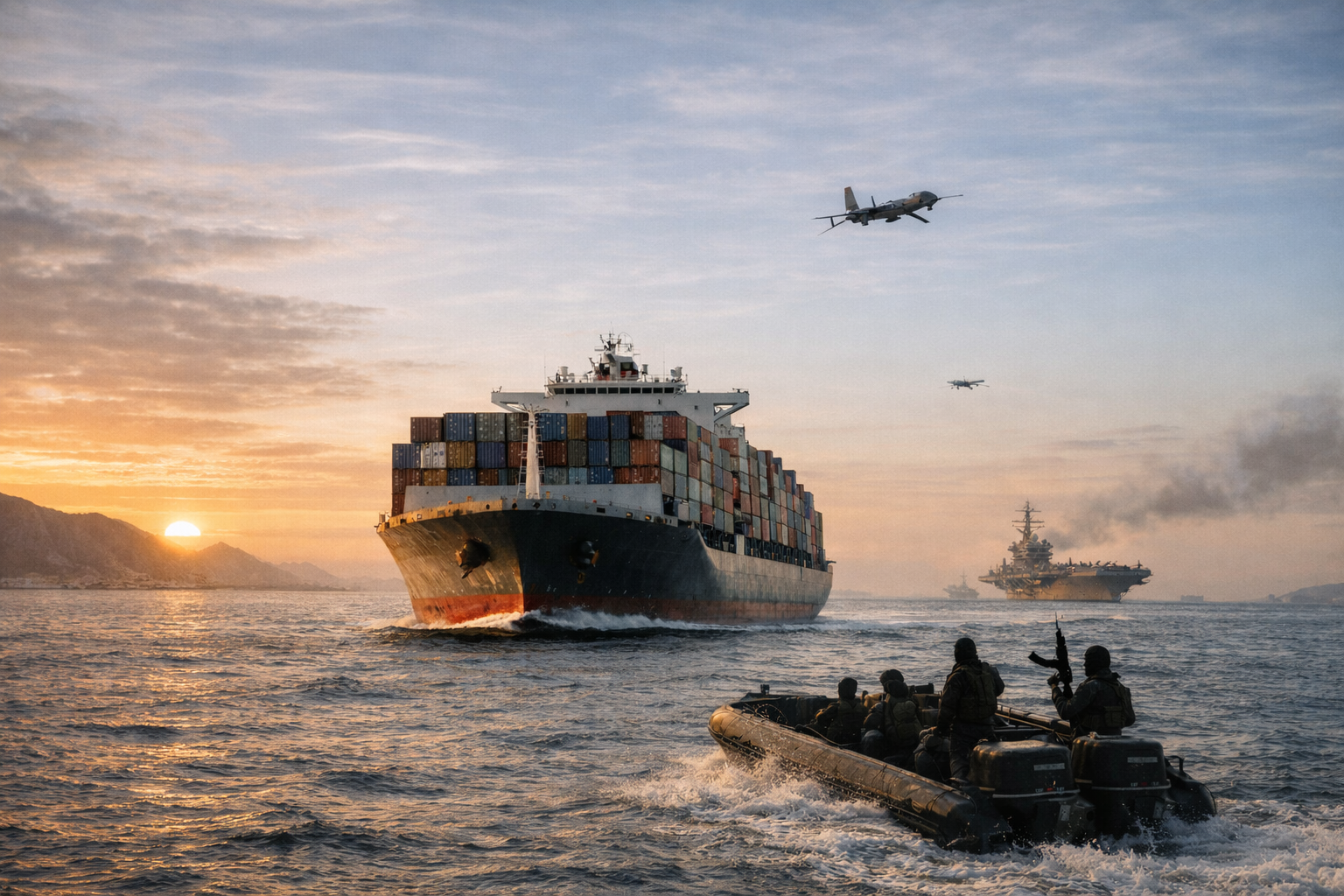
The global container shipping industry has once again been reminded of an uncomfortable truth it would prefer to forget: efficiency without resilience is fragile. The recent about-face by CMA CGM, scaling back plans to reroute multiple Asia–Europe westbound services through the Red Sea and Suez Canal, underscores how quickly strategic assumptions can collapse in the face of geopolitical reality. Only weeks after announcing a cautious return to the Suez route, the French carrier reversed course, citing a “complex and uncertain international context.”
This decision, coming alongside Maersk’s move to resume Suez transits on its MECL service from India to the US East Coast, captures the defining feature of today’s ocean freight environment: volatility layered on top of systemic uncertainty. For shippers, forwarders, and beneficial cargo owners, the implications extend far beyond transit times or bunker costs. This is about risk allocation, reliability, and the fundamental reshaping of procurement strategies in a world where disruption is no longer episodic, but structural.
The Red Sea and Suez Canal represent one of the most critical arteries in global trade, linking Asia with Europe and the US East Coast. Under normal conditions, Suez transits shave up to ten days off Asia–Europe voyages compared with routing via the Cape of Good Hope. In a purely commercial environment, that time saving would be decisive.
But the environment is anything but normal.
Since late 2023, Iran-backed Houthi attacks on commercial shipping have transformed the Red Sea into a high-risk theater. Although attacks paused in November, and optimism grew following the Israel–Hamas ceasefire, the underlying drivers of instability never disappeared. Recent warnings from Houthi forces, combined with the arrival of a US carrier strike group in the Gulf of Oman and renewed threats of US military action against Iran, have reignited fears that the region could quickly slide back into active conflict.
For ocean carriers, this creates a brutal calculus. A return to Suez offers competitive transit times and improved asset utilization. At the same time, it exposes crews, vessels, cargo, and brand reputation to potentially catastrophic risk. A single high-profile incident would not only disrupt networks overnight, but could undo years of trust-building with customers and insurers.
CMA CGM’s decision to keep its FAL 1, FAL 3, and MEX services routed via the Cape of Good Hope reflects a sober recognition of that reality. Even with war risk premiums having fallen sharply from their peak, the downside risk of being wrong still far outweighs the upside of being early.
What is emerging instead is a hybrid routing model, one that blends caution with commercial necessity. As Drewry’s Simon Heaney has noted, carriers are increasingly willing to test Suez transits on backhaul legs or lower-value cargo, while keeping high-value head-haul shipments on the longer but safer Cape route.
This approach serves several purposes simultaneously:
- It limits exposure of premium cargo to volatile security conditions.
- It allows carriers to gradually reintroduce effective capacity without flooding the market.
- It buys time to assess whether the absence of attacks is durable or merely temporary.
Critically, it also prevents a sudden capacity shock. A full-scale return to Suez by all major alliances would effectively release weeks of latent capacity back into the market. In an industry already grappling with the largest order book in history, that would place enormous downward pressure on freight rates.
Even under a staggered return scenario, analysts broadly agree that rates will trend lower through 2026. HSBC has warned that while a rapid Suez reopening could cause a short-term rate bump, the structural overcapacity problem would reassert itself quickly, weighing on both spot markets and annual contract negotiations.
The difference this time is that price erosion is not translating into shipper complacency.
For much of the past decade, ocean freight procurement was dominated by rate chasing. Service failures were tolerated as long as the landed cost looked good on a spreadsheet. That mindset is now breaking down.
Shippers have been burned too many times, first by the pandemic, then by port congestion, labor disruptions, canal closures, and now geopolitical conflict. The lesson has landed: cheap freight that does not arrive on time, or at all, is not cheap.
This shift is evident in how contracts are being structured. Many Asia–Europe agreements for 2025 already include dual-rate mechanisms, one rate for Cape routing and another for Suez, or explicit review clauses triggered by a full resumption of Red Sea transits. These provisions acknowledge uncertainty upfront rather than pretending it does not exist.
At the same time, C-suite directives at many multinational shippers now explicitly prohibit routing cargo through the Red Sea, regardless of transit-time advantages. Others are willing to consider it, but only if insurance coverage, visibility, and carrier accountability are crystal clear.
That last condition is proving difficult to meet.
Carrier alliances complicate risk management in ways many cargo owners still underestimate. A shipper may book with a carrier that publicly avoids Suez, only to find their container loaded onto a partner vessel transiting the Red Sea.
From an insurance standpoint, this matters. War risk coverage often requires specific rider endorsements tied to voyage routing. Without precise, voyage-level visibility, shippers can find themselves exposed despite acting in good faith.
Industry experts warn that carriers are unlikely to publish highly granular routing plans in advance, particularly under fluid security conditions. That creates a visibility gap at exactly the moment when shippers need clarity most.
The burden, unfair as it may be, increasingly falls on shippers and their logistics partners to ask harder questions, demand better communication, and maintain contingency plans.
Plan A is no longer enough. Neither is Plan B.
A persistent narrative in shipping analysis holds that once Suez fully reopens, excess vessel capacity will crush rates. That view, while directionally correct, ignores a critical constraint: ports.
China’s major gateways, particularly Shanghai and Ningbo, are already operating under chronic congestion. Ships routinely wait days at anchor. Contrary to long-held assumptions, China is now facing a shortage of effective port capacity just as its export engine accelerates.
The ships calling these ports are also fundamentally different. Ultra-large container vessels of 18,000 to 24,000 TEUs turn each port call into a major logistical event. Even with advanced automation, moving that volume stresses yard space, labor availability, and hinterland connections.
Port performance data confirms the strain. Globally, vessel turnaround times remain well below pre-pandemic efficiency levels, even after normalizing for workload. In practical terms, this means that any capacity “released” by shorter ocean transits is quickly absorbed by congestion on land.
The bottleneck has shifted, not disappeared.
The year ahead will not deliver the windfall many shippers hoped for when diversions around Africa became the norm. Rates may soften by a few hundred dollars per container, but the idea of a sustained collapse is increasingly unrealistic.
More importantly, volatility is now a permanent feature of the landscape. Security risks, political brinkmanship, infrastructure limitations, and carrier capacity management are interacting in ways that defy clean forecasting models.
In this environment, resilience becomes a competitive advantage.
That means:
- Prioritizing carrier reliability and transparency over marginal rate savings.
- Building contractual flexibility rather than locking into rigid assumptions.
- Investing in real-time visibility and expert market intelligence.
- Working with logistics partners who understand not just freight, but risk.
PNG Worldwide is not observing this environment from the sidelines. We are actively managing it.
We are in continuous contact with ocean carriers, alliance partners, insurance intermediaries, and our local offices to understand not only what is being announced publicly, but what is actually happening at the vessel, voyage, and network level. That intelligence is translated directly into guidance for our customers, in real time.
We challenge routings when risk outweighs reward. We pressure carriers for clarity when networks change. We advise customers before disruptions materialize, not after service failures occur. When conditions deteriorate, we do not default to inertia, we execute contingency plans.
Our role is not to sell optimism or chase marginal rate improvements. Our role is to ensure cargo moves with the highest possible level of certainty in an uncertain world. That means proactive communication, disciplined execution, and accountability at every handoff.
In a market defined by reversals and volatility, PNG Worldwide operates with one objective: to make sure our customers’ shipments are protected, visible, and delivered, regardless of how often the rules of the game change.
The Red Sea crisis is not an isolated episode. It is a manifestation of deeper forces reshaping global trade, from geopolitical fragmentation to infrastructure saturation and shifting power dynamics.
For ocean carriers, the challenge is to balance competitiveness with caution. For shippers, it is to procure transportation that delivers products, not just rates. And for logistics partners, it is to bridge that gap with insight, execution, and trust.
The industry is relearning an old lesson under new conditions: resilience is not the opposite of efficiency, it is its prerequisite. In 2025 and beyond, the winners will not be those who paid the least per container, but those who ensured their supply chains kept moving when others stalled.
That is the reality. And it is not going away.
View All News Articles